Corrosion and damage documentation — Pipeline and field applications
At pipeline excavations and CUI inspection sites, accurate documentation of corrosion morphology, mechanical damage, dents, and bulges is critical for Fitness-for-Service evaluation and repair planning. Manual pit gauge measurements are slow, operator-dependent, and limited to point data. Those gaps in the damage profile can lead directly to inaccurate repair decisions.
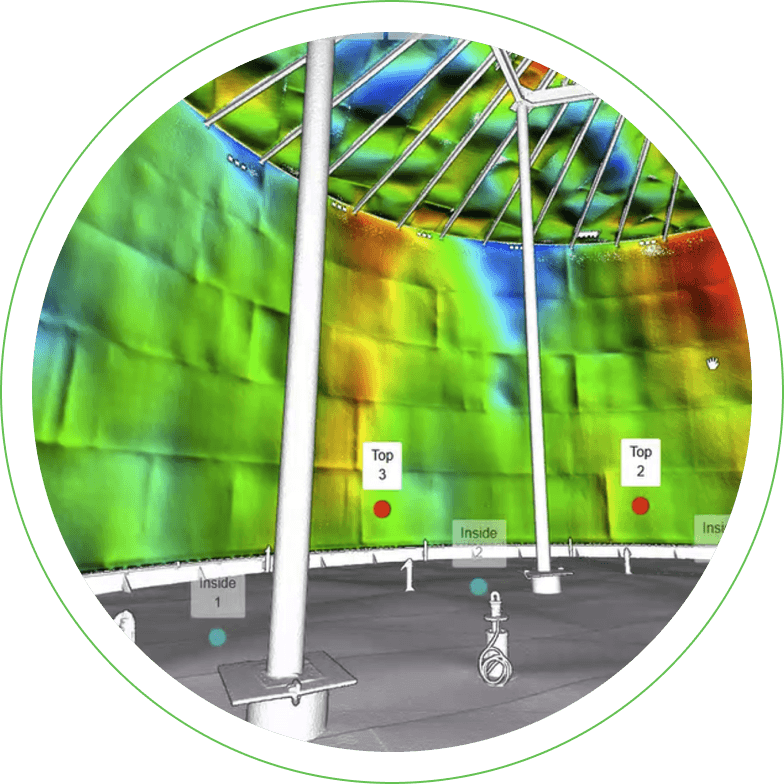
MISTRAS deploys portable, metrology-grade handheld 3D laser scanners to capture complete, high-resolution surface geometry of exposed pipeline damage in the field. The scanner creates a full 3D mesh of the affected area in minutes, documenting corrosion depth and extent, dent profiles, bulge geometry, and mechanical damage features with high accuracy. Analytical software automatically generates detailed assessments of corrosion severity, remaining wall thickness, and burst pressure calculations. The result is engineering-grade documentation that supports B31G, modified B31G, and other Fitness-for-Service methodologies. Results are repeatable and traceable, with data archived for direct comparison at subsequent inspections.
The same handheld scanning capability is used for CUI mapping, providing rapid, comprehensive documentation of corrosion extent and morphology on exposed piping and vessels following insulation removal.