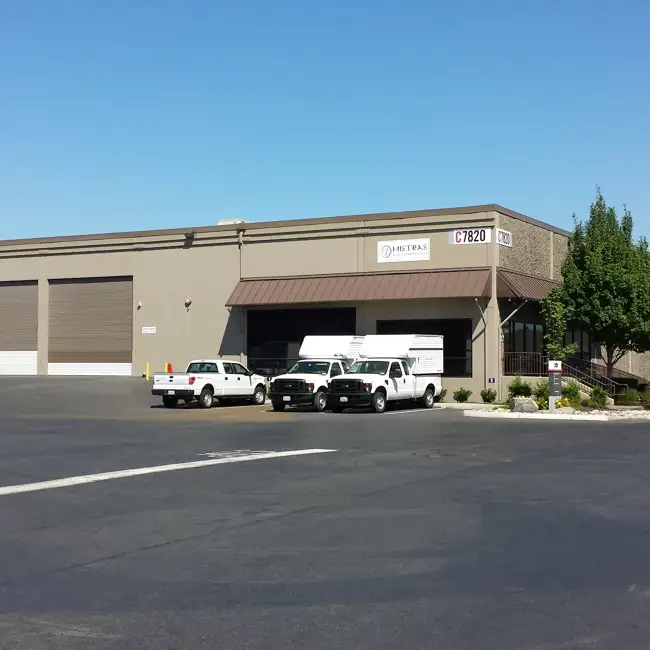
Kent (Seattle), WA – USA
Field Services Branch, In-House Laboratory
Our 40,000 sq. ft. field services and in-house testing lab in Kent (Seattle), WA - USA provides Non-Destructive Testing (NDT) of materials, welds, fabrication, and structures to ensure quality for new or in-service applications in a wide variety of industries. Our NDT solutions include Ultrasonics (UT), Radiography (RT), Eddy Current (EC), Penetrant (PT), Magnetic Particle Testing (MT), Visual Testing (VT), Certified Weld Inspection (CWI), Ground Penetrating Radar (GPR), advanced services for specialized inspection applications, and more.
Read MoreWe specialize in aerospace materials inspection, including NDT of composite materials and fabricated structures, with the quality program, leadership, and experience to support. Our qualifications include AS9100D/ISO 9001, Nadcap accreditation, NAS 410, FAA, and ITAR/EAR, along with commercial and military approvals. We are approved to many aerospace prime manufacturers, including Boeing, Airbus, Bombardier, Honda Aircraft, Bell Helicopter, MD Helicopter, Spirit AeroSystems, and others. Our lab is an FAA-certified repair station, and we are ITAR-registered.
Along with Aerospace services, we provide a wide range of NDT services including API-653, API-570, API-510, and STI, as well as a variety of professional engineering services, including API-579, fitness for service, and finite element analysis.
Suite 110
Kent, WA 98032
United States
Sat-Sun: Closed
Sat-Sun: Closed
General Manager
Phone: 1 (360) 755-9350
Email: austin.polczynski@mistrasgroup.com
Quality Manager
Phone: 1 (206) 764-8123
Email: michelle.taylor@mistrasgroup.com
Lab Manager
Phone: 1 (206) 746-8123
Email: darren.brown@mistrasgroup.com
Accreditations


Certifications
Prime Approvals















Specialties
Achieve new levels of intelligence
Partner with MISTRAS to empower your teams to achieve new levels of reliability, safety, and operational performance.
Schedule expert consultation


Applications
Corrosion/Erosion
Build-up and deterioration from natural and operational causes

Cracking
Physical reactions to stress and operating environments

Fatigue
Residual stress from loads, temperature, and other factors
Faults
Structural, mechanical, and electrical
Flaws
Defects in newly-manufactured components
Leaks
Gas, liquid, and steam leaks in operating equipment