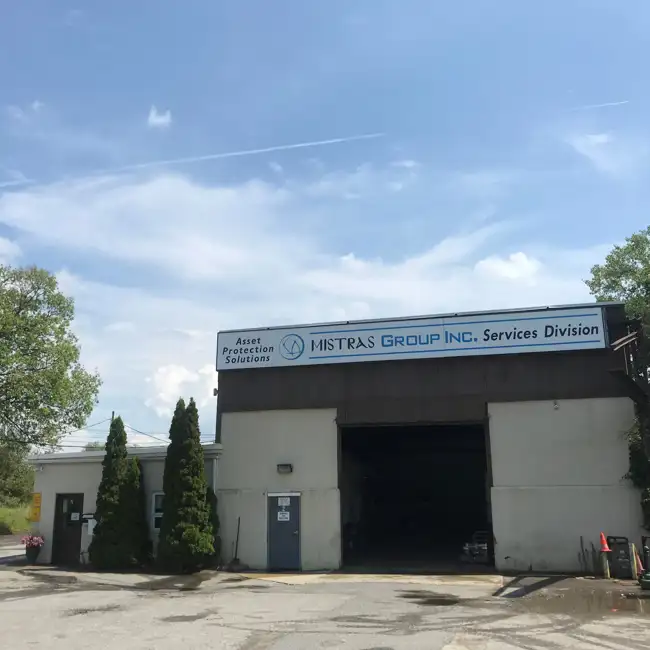
Boston, MA - USA
In-House Laboratory, Field Services Branch
MISTRAS Group’s Auburn, MA – USA branch is a leader in traditional Non-Destructive Testing (NDT) services for both in-lab and field testing in the Northeast region of the United States.
Read MoreLocated in Central Massachusetts, the lab offers both High & Low Voltage Radiographic Testing (RT) & Computed Radiography (CR), Ultrasonic Testing (UT), Magnetic Particle Testing (MT), Penetrant Testing (PT), Visual Testing (VT), Physical Testing, and Level III services. Having the only 4 MEV X-ray unit on the east coast allows for testing of heavy castings and other materials up to 10 inches thick.
The Auburn lab can test structural and weld integrity on various assets such as heavy and light casting, forgings, raw stock, semi-finished, finished, welded and non-welding parts. We successfully serve many industries including Aerospace, Manufacturing, Power Generation, Petrochem, Medical, and others.
In the field, the lab uses Gamma RT, MT, UT, PT, VT and level III services to work with various companies to ensure the mechanical and structural integrity of their assets. Such testing is used on, but not limited to, piping, pressure vessels, tanks, infrastructure, industrial equipment, and production parts.
Maximizing safety, compliance, and uptime has been our business for over 45 years.
Auburn, MA 1501
United States
Sat-Sun: Closed
Northeast Regional Manager
Phone: 1 (610) 497-0400
Email: Collin.Eckerd@mistrasgroup.com
QA/QC Manager
Phone: 1 (508) 832-5500
Email: douglas.mendes@mistrasgroup.com
QA/RSM
Phone: 1 (508) 832-5500
Email: ron.havens@mistrasgroup.com
Assistant RSM
Phone: 1 (508) 832-5500
Email: Dennis.Havens@mistrasgroup.com
Sales Manager
Phone: +1 (978) 270-3792
Email: sean.byrne@mistrasgroup.com
Accreditations

Certifications
Prime Approvals









Achieve new levels of intelligence
Partner with MISTRAS to empower your teams to achieve new levels of reliability, safety, and operational performance.
Schedule expert consultation


Applications
Corrosion/Erosion
Build-up and deterioration from natural and operational causes
Cracking
Physical reactions to stress and operating environments
Fatigue
Residual stress from loads, temperature, and other factors
Faults
Structural, mechanical, and electrical
Flaws
Defects in newly-manufactured components
Leaks
Gas, liquid, and steam leaks in operating equipment